policy
Government funding for new rail infrastructure falls 12% to £8.7bn, ORR figures show
The Office of Rail and Road's annual Rail Industry Finance statistics for 2025-26 show HS2 and Network Rail enhancement funding down 12%, with a combined East West Rail, Core Valley Lines and other category down 21%.

Government funding for new railway infrastructure fell 12% to £8.7bn in 2025-26, with about three-quarters of it going to HS2, according to annual finance statistics published by the Office of Rail and Road (ORR) on 26 November.
The regulator's Rail Industry Finance figures show total public funding for rail operations and infrastructure enhancements combined was £20.9bn, a 6% decrease on the previous year.
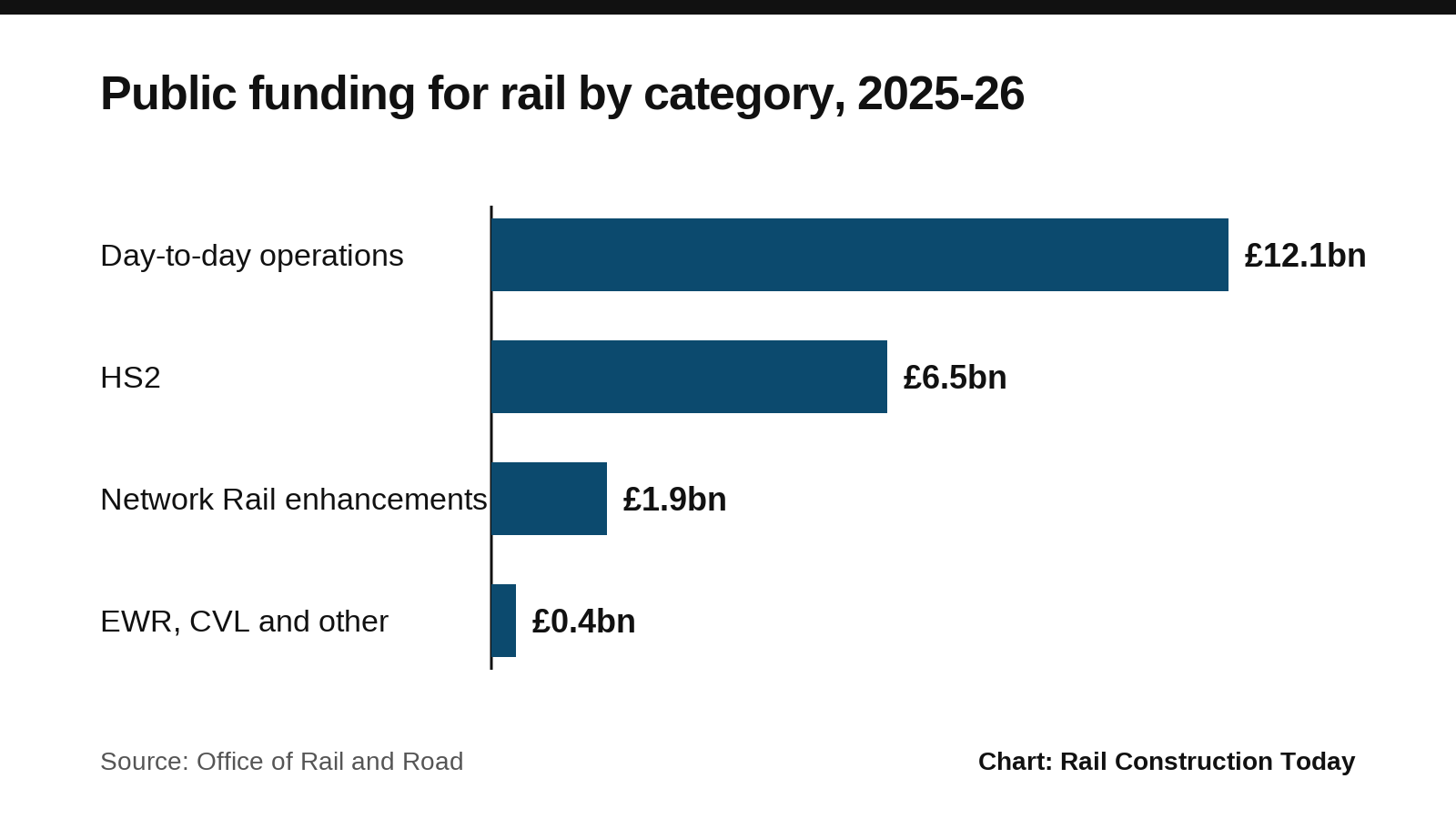
Within that total, £6.5bn went towards the continued development of HS2, a 12% annual decrease, and £1.9bn to Network Rail enhancement initiatives, also down 12%. A further £0.4bn went to other parts of the industry, including enhancement funding for East West Rail and Core Valley Lines, a 21% decrease.
Private companies invested £0.6bn in the rail industry, 17% less than the previous year, ORR said.
Public funding in 2025-26
| Category | Funding | Annual change |
|---|---|---|
| Day-to-day operation of the railway | £12.1bn | down 1% |
| HS2 | £6.5bn | down 12% |
| Network Rail enhancements | £1.9bn | down 12% |
| East West Rail, Core Valley Lines and other | £0.4bn | down 21% |
Source: ORR
Total income and funding for the Great Britain rail network was £36.5bn, made up of £27.1bn for operating and maintaining the railway and £9.4bn for new investment from government and private sources combined.
Fares and journeys
Passenger fares income rose 4% to £12.4bn, below the 6% rise in passenger journeys and the 5% rise in passenger kilometres. ORR said this continued a trend of recent years and reflected the Elizabeth line, where fares are relatively lower and journeys relatively shorter, passengers on average taking shorter journeys, and the different approaches used to set regulated fares.
The regulator's own table shows annual growth in fares income slowing each year since the post-pandemic rebound: 206% in 2021-22, 34% in 2022-23, 14% in 2023-24, 8% in 2024-25 and 4% in 2025-26.
Income for the operational railway across train operators and infrastructure managers increased 1% to £27.1bn. The ORR data portal gives the inflation-adjusted rise as 1.2%.
Governments' financial support for operating the railway fell 1% to £12.1bn from £12.3bn. The press release puts this at 45% of total industry income, compared with 46% a year earlier; the unrounded data portal figures are 44.6% and 45.8%.
ORR said government funding has reduced substantially from its pandemic peak of £21.7bn, in 2025-26 prices, but remains above the £8.3bn provided in 2019-20, when it represented 32% of operational railway income.
Costs and dividends
Operating expenditure excluding financing costs was unchanged at £24.3bn. Including financing costs it was £27.3bn, up £410m, which ORR said was mostly due to a rise in Network Rail's financing costs on historical debt. The press release rounds the increase to 2%; the data portal gives an inflation-adjusted figure of 1.5%. Expenditure covers staff costs, fuel and rolling stock.
Thirteen of 20 train operators were expected to pay dividends totalling £158m, down 21%, with publicly owned operators accounting for 34% of the expected total.
Rolling stock companies' net profit margins rose three percentage points to 22%, while their dividends to shareholders fell 59% to £116m.
Historic data has been adjusted to April 2025 to March 2026 prices using the average quarter-on-quarter Consumer Price Index for the year. The statistics cover Network Rail, franchised and open access passenger operators and other sectors of the UK rail industry including Northern Ireland, along with government support.
What happens next
ORR's separate quarterly usage figures show journey growth continuing into 2026-27, with 461 million passenger journeys in Great Britain in April to June 2026, up 2% on the 451 million in the same quarter of 2025. Passenger kilometres rose 2% to 17.5 billion.
The next quarterly passenger rail usage release is due on 17 December 2026. The date of the next Rail Industry Finance publication is listed as to be confirmed.
On the record: Office of Rail and Road
Sources
- Office of Rail and Road (opens in a new tab) (accessed 2026-11-26)
- Office of Rail and Road (ORR Data Portal) (opens in a new tab) (accessed 2026-11-26)
- Office of Rail and Road (ORR Data Portal) (opens in a new tab) (accessed 2026-11-26)
This story was researched from the primary sources above and checked against them before publication. Spotted an error? Tell us and we will correct it promptly.