policy
ORR rejects new West Coast Main Line services as Network Rail plans fewer renewals
The regulator's November newsletter confirms it turned down Wrexham, Rochdale and Blackpool applications, while its own figures show 50.8km of electrification added last year and lower renewals volumes ahead.
The Office of Rail and Road (ORR) has rejected applications for new passenger services between London and Wrexham, Rochdale and Blackpool, ruling that the southern West Coast Main Line cannot take more trains without worsening delays.
The decision, announced on 8 October 2026 and restated in the regulator's November newsletter published on 30 October, turned down the Wrexham, Shropshire & Midlands Railway Company's bid for four return Wrexham to London Euston services, Lumo's application for up to four return Rochdale to Euston services and Avanti West Coast's request for additional Blackpool to Euston services.
ORR approved one application: Avanti's weekday 19:29 Chester to Euston service can carry passengers until December 2030. The newsletter said the train already runs as empty coaching stock, so no additional train would be added to the network.
Stephanie Tobyn, ORR's director of strategy, policy and reform, said: "Our detailed analysis has shown that adding more trains to the current timetable would reduce the ability to recover when disruption occurs, increasing the risk of delays spreading and making reliability of the network worse for all passengers."
The capacity assessment
ORR said the capacity and performance of the southern section of the West Coast Main Line had not materially changed since it rejected similar applications in 2025. In July 2025 it refused bids from WSMR, Lumo NW and Virgin Trains on the grounds of insufficient capacity.
An external review commissioned by the regulator supported its conclusion, ORR said. It added that putting more services into the timetable's recovery windows would reduce the route's resilience.
Tobyn said: "New services, destinations and greater choice can bring real benefits for passengers and communities." ORR described its role as ensuring passenger and freight operators have fair access to the network and that best use is made of finite capacity.
Infrastructure added in 2025-26
The decision comes against figures from ORR's own rail infrastructure and assets statistics for 2025-26, published on 22 October 2026. The regulator said 50.8km of electrified track were added to the network in the year, which it attributed to sections of the Transpennine Route Upgrade, the electrification of the Glasgow to East Kilbride line and the opening of two new stations.
Six new stations opened in 2025-26, taking the total number of mainline stations in Great Britain to 2,595 at 31 March 2026, ORR said.
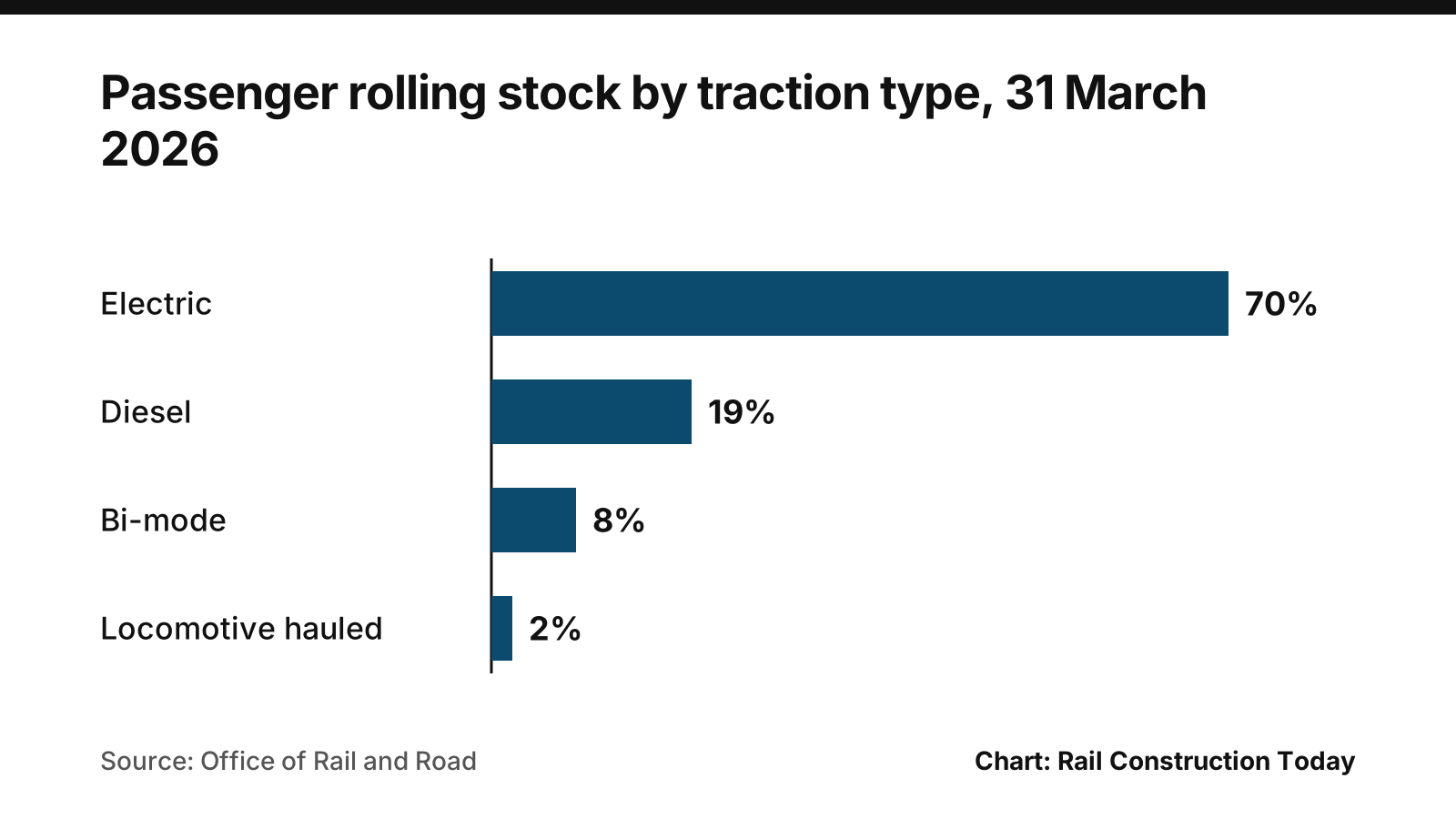
The same release recorded 15,419 railway vehicles registered in operation for passenger operators at 31 March 2026, with an average age of 16.4 years. The fleet split by traction was:
| Traction type | Share of fleet |
|---|---|
| Electric | 70% |
| Diesel | 19% |
| Bi-mode | 8% |
| Locomotive hauled | 2% |
Renewals and asset condition
ORR's annual assessment of Network Rail for 2025-26 found the infrastructure owner delivered £614m of efficiencies in Year 2 of Control Period 7 (CP7).
But the regulator said Network Rail was now unlikely to achieve its CP7 asset condition targets in England and Wales, and was planning much lower volumes of renewals in England and Wales across the rest of the control period. Deferring work would increase future investment requirements, ORR said, and an increasingly ageing asset base had implications for asset reliability, performance and safety.
At year end, 65.9% of trains arrived On Time against a target of 67.2%, according to the assessment.
Digital safety strategy
For signalling and digital projects, the newsletter pointed to ORR's digital safety strategy, published on 28 September alongside a strategic risk chapter. The strategy sets out the regulator's approach to managing health and safety risks arising from digital systems.
It identifies nine principal digital safety issues. The first is that digital failures differ from electro-mechanical failures; others include poorly controlled change, which ORR lists as a primary trigger, supply chain and third-party dependency, data integrity, fail-safe and resilience risks and malicious disruption.
ORR said organisations should be able to identify, assess and control risks arising from digital systems as the technologies become more widely used.
Worker welfare
The newsletter also reported that senior industry leaders agreed a national action plan on welfare facilities for railway workers at a Rail Safety and Standards Board (RSSB)-led event supported by ORR.
In its 2025-26 annual health and safety report, ORR said 26 organisations had signed the industry Welfare Charter but that progress had been uneven and momentum had slowed, and a refocused programme was under way with RSSB. The regulator said it would continue to assess welfare provision through inspections and engagement.
RSSB said the charter aims to address the shortage of welfare facilities across the network; signatories include Network Rail Infrastructure Limited, Avanti West Coast, c2c Railway Ltd, Chiltern Railways and DB Cargo UK.
Separately, ORR's consultation on a draft Retail Code of Practice for the online ticket market under Great British Railways closes on 11 December 2026.
On the record: Office of Rail and Road
Sources
- Office of Rail and Road (opens in a new tab) (accessed 2026-11-01)
- Office of Rail and Road (opens in a new tab) (accessed 2026-11-01)
- Office of Rail and Road (opens in a new tab) (accessed 2026-11-01)
- Office of Rail and Road (opens in a new tab) (accessed 2026-11-01)
- Office of Rail and Road (opens in a new tab) (accessed 2026-11-01)
- Office of Rail and Road (opens in a new tab) (accessed 2026-11-01)
- Rail Safety and Standards Board (opens in a new tab) (accessed 2026-11-01)
This story was researched from the primary sources above and checked against them before publication. Spotted an error? Tell us and we will correct it promptly.