HS2
HS2 miners break through into Old Oak Common station box after 100,000-tonne dig
Skanska Costain STRABAG teams have completed the second of two sprayed concrete lined tunnels into HS2's west London station, creating an 8.8-mile link to the West Ruislip portal.
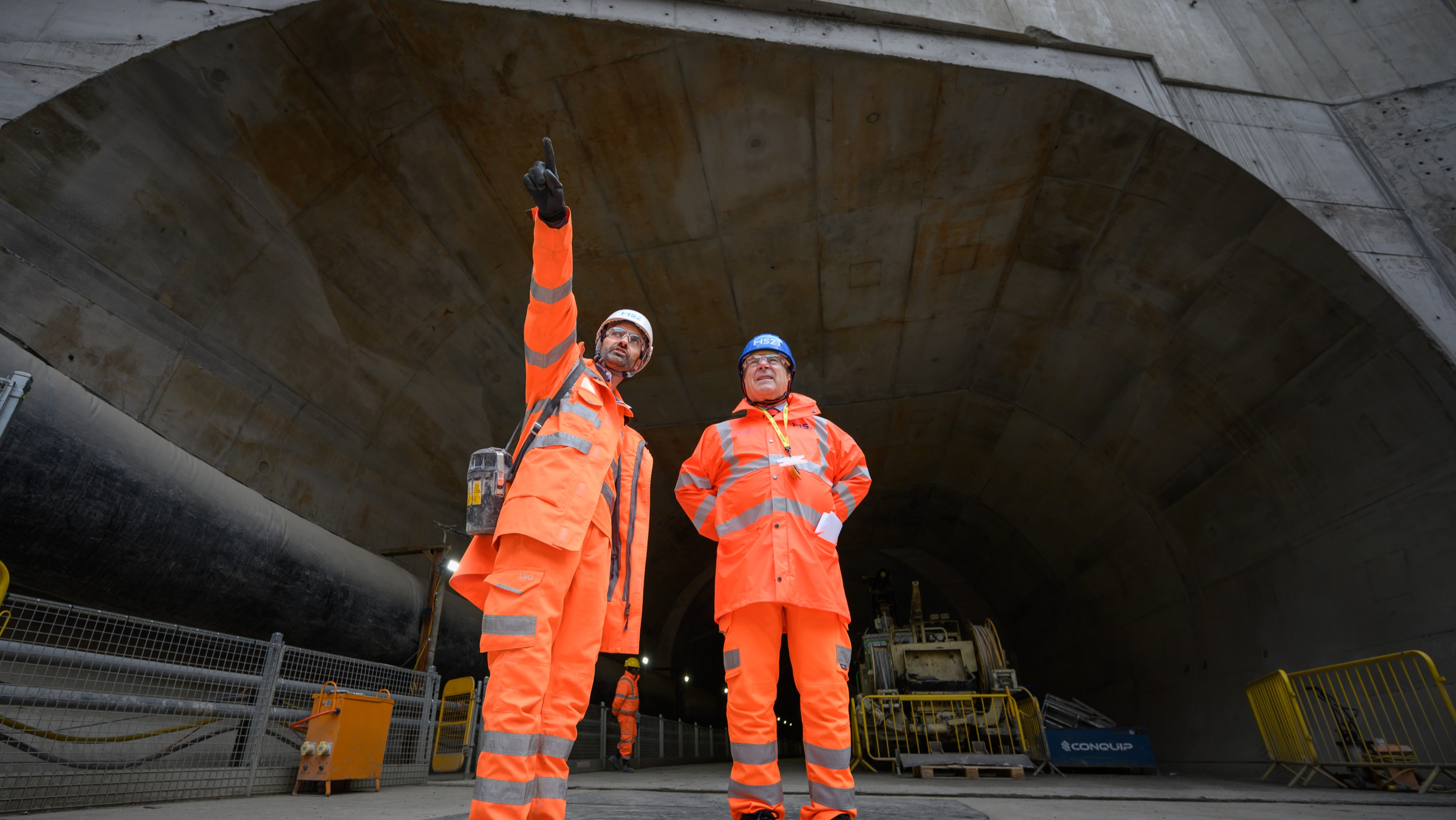
Tunnel mining teams have broken through into HS2's Old Oak Common station box in west London after excavating 100,000 tonnes of London clay, HS2 Ltd said on 4 November 2026.
The breakthrough completes the second of two 360-metre tunnels running between the Victoria Road crossover box and the station. HS2 Ltd said the northbound tunnel broke through on 13 October.
Together the two tunnels create an 8.8-mile link between Old Oak Common station and the West Ruislip tunnel portal, according to HS2 Ltd. The company said all deep bore tunnelling between London and Birmingham is now complete and more than 80% of major structures are under construction or complete.
Mark Wild, HS2 Ltd chief executive, said the breakthrough "helps bring us a step closer to achieving our challenging ambition of delivering the railway from Old Oak Common to Birmingham Curzon Street by 2037, or earlier."
Why the tunnels were mined by hand
Unlike most of HS2's bored tunnels, which were driven by tunnel boring machines (TBMs), the Old Oak Common tunnels were dug with excavators and lined with sprayed concrete, HS2 Ltd said. The company said work started from the Victoria Road crossover box site in May 2024.
HS2 Ltd's own FAQ on the tunnel explains why a TBM could not be used: the tunnel diameter varies between 8.9 metres and 14.9 metres as the two bores approach the station. The trigger release puts it the other way round, saying the tunnels narrow from two tracks to one between the crossover box and the station, which dictated the construction method.
The FAQ describes the technique used by the contractor, SCS, as a cyclic excavation and support method, also known as sprayed concrete lining. The tunnel crown sits about 12 metres below ground, it said.
After the sprayed concrete, the tunnels were lined with cast in situ concrete using travelling formwork, HS2 Ltd said. The company said all 100,000 tonnes of excavated material has gone to reuse projects in the UK.
Both breakthroughs used a process not previously employed on HS2. Instead of mining through from the tunnel side, HS2 Ltd said the dividing wall was cut into blocks and pushed out from the station side back into the completed tunnel behind.
David Hannon, Skanska Costain STRABAG operations managing director, said: "Our breakthrough into the Old Oak Common station box is a significant milestone for the project."
The breakthrough does not mark the end of the job. HS2 Ltd's FAQ says construction of the Old Oak Common tunnel is expected to finish in winter 2026/2027.
The crossover box
The Victoria Road Crossover Box at the northern end of the tunnels will allow HS2 trains to switch tracks underground, HS2 Ltd said. The box is 130m long and 25m underground, with three headhouses at ground level, and was designed and built by the Costain/Skanska/STRABAG joint venture, SCS Railways.
HS2 Ltd said the box was also used to launch two of the four TBMs for the tunnels between Old Oak Common and Ruislip.
Station progress
Old Oak Common will have 14 platforms, six for high-speed services and eight for conventional services, according to HS2 Ltd's station page, which forecasts up to 250,000 passengers a day. The station will be the 42nd stop on the Elizabeth line, and Network Rail is working with HS2 Ltd to connect it to the existing rail network.
Excavation of the 20-metre-deep station box is finished. HS2 Ltd said in August 2026 that the six 450m underground platforms were in place ready for further fit out. They are made of 1,946 slabs, each up to 2m by 4m and weighing four to five tonnes, with station construction partner Balfour Beatty Vinci SYSTRA (BBVS) overseeing the work. Installation of the station roof is due to start in 2027.
At the eastern end of the box, two 1,624-tonne TBMs are driving the 4.5-mile twin-bore tunnel to Euston. HS2 Ltd said the first, Madeleine, was switched on by Lord Hendy and Darren Jones on 27 January 2026, and the second, Karen, the last of 11 tunnelling machines built for HS2, launched on 16 March 2026. Both are expected to reach Euston in mid-2027.
Cost and opening dates
Wild's reference to 2037 "or earlier" sits alongside a wider range set out by the Department for Transport (DfT) in its May 2026 six-monthly report to Parliament. The DfT put the expected cost of delivering HS2 at £87.7bn to £102.7bn, and described HS2 Ltd's stretch goal as delivering the programme for £93.2bn with an initial opening date of late 2037.
The opening stage will see the first trains run between Old Oak Common and Birmingham Curzon Street, the DfT said. HS2 Ltd said passengers will travel about 140 miles between the two stations in around 45 minutes.
Both HS2 Ltd and the DfT said the company delivered more than 10% more construction than planned in 2025/26 and reached six major milestones ahead of schedule. Wild said the company is in the final stages of a fundamental reset of the entire HS2 programme; the DfT said those final stages are expected to conclude in the first half of 2027.
On the record: Department for Transport
Sources
- HS2 Ltd (opens in a new tab) (accessed 2026-11-05)
- HS2 Ltd (opens in a new tab) (accessed 2026-11-05)
- HS2 Ltd (opens in a new tab) (accessed 2026-11-05)
- HS2 Ltd (opens in a new tab) (accessed 2026-11-05)
- HS2 Ltd (opens in a new tab) (accessed 2026-11-05)
- HS2 Ltd (opens in a new tab) (accessed 2026-11-05)
- HS2 Ltd (opens in a new tab) (accessed 2026-11-05)
- Department for Transport (GOV.UK) (opens in a new tab) (accessed 2026-11-05)
This story was researched from the primary sources above and checked against them before publication. Spotted an error? Tell us and we will correct it promptly.